
Impacted
+13.8K
Organizations in Communities
Trained
+61.7K
Individuals Working with Fathers

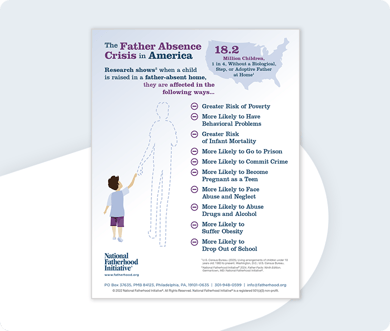
According to the U.S. Census Bureau, 18.2 million children, 1 in 4, live without a biological, step, or adoptive father in the home.*
That’s enough children to fill New York City twice or Los Angeles four times over.
Research shows that a father's absence affects children in numerous unfortunate ways,
while a father's presence makes a positive difference in the lives of both children and mothers.
*U.S. Census Bureau. (2025). Living arrangements of children under 18 years old: 1960 to present. Washington, D.C.: U.S. Census Bureau.

What We Know:
Father involvement provides numerous benefits for child well-being, starting prenatally and lasting into adulthood. Engaged fathers enhance cognitive skills, reading proficiency, and self-esteem, while reducing risks of poor birth outcomes, poverty, food insecurity, and behavioral issues.

Father–youth intimacy is associated with fewer depressive symptoms for boys and girls across most of adolescence.
Source: Hochgraf, A. K., Fosco, G. M., Lanza, S. T., & McHale, S. M. (2021). Developmental timing of parent–youth intimacy as a protective factor for adolescent adjustment problems. Journal of Family Psychology, 35(7), 916–926.
Fathers’ play in the early years can positively contribute to children’s social, emotional, and cognitive outcomes.
Source: Amodia-Bidakowska, Laverty, C., & Ramchandani, P.G. (2020). Father-child play: A systematic review of its frequency, characteristics and potential impact on children’s development. Developmental Review, 57, Article 100924.

Our unique research publication, Father Facts™ is packed with the most comprehensive data and research available on the benefits of father involvement and the negative impacts of father absence.
.png?width=676&height=622&name=Frame%20427320807%20(1).png)
What We Know:
When fathers are involved with their children, the mothers of those children receive many benefits. These benefits include more leisure time, a healthier birth, lower rates of postpartum stress and depression (and depression and stress generally), and a higher-quality co-parenting relationship.
Greater father involvement is negatively associated with maternal depressive symptoms.
Source: Maselko, J., Hagamann, A. K., Bates, L. M., Bhalotra, S., Biroli, P., Gallis, J. A., O’Donnell. K., Sikander, S., Turner, E. L., & Rahman, A. (2019). Father involvement in the first year of life: Associations with maternal mental health and child development outcomes in rural Pakistan. Social Science and Medicine, 237, Article 112421.
Involved dads reduce moms’ parenting stress.
Source: Nomaguchi, K., Brown, S., & Leyman, T. (2017). Fathers’ participation in parenting and maternal parenting stress: Variation by relationship status. Journal of Family Issues, 38, 1132-1156.
Our unique research publication, Father Facts™ is packed with the most comprehensive data and research available on the benefits of father involvement and the negative impacts of father absence.

What We Know:
Child maltreatment involves various factors at community, family, and individual levels. Most perpetrators are parents, but father involvement can protect children, especially if the perpetrator is the other parent. Nonresident fathers’ support, including informal and formal child support, can help prevent neglect, which often stems from economic resource shortages in single-parent families poverty.
Quality father-child interactions are associated with reduced risks of maltreatment and improved outcomes for children.
Source: Annie E. Casey Foundation. (2024). Why should child protection agencies engage and involve dads? Retrieved from https://www.casey.org/father-engagement-strategies/
Nonresident fathers’ formal or informal child support agreements, on-time payments, in-kind support, and direct care significantly moderate the association between mothers’ transitions to being single and the risk of child neglect.
Source: Schneider, W. (2017). Single mothers, the role of fathers, and the risk for child maltreatment. Children and Youth Services Review, 81, 81-93.
Our unique research publication, Father Facts™ is packed with the most comprehensive data and research available on the benefits of father involvement and the negative impacts of father absence.
.png?width=676&height=622&name=Frame%20427320807%20(3).png)
What We Know:
Father involvement is a significant factor in a child's success in school and beyond. By actively participating in their children's education, fathers can make a lasting positive impact on their children's lives. While both mothers and fathers play crucial roles in a child's development, research suggests that father involvement has a unique and independent influence on children's educational outcomes, even when considering the mother's involvement.
Children with involved dads have fewer behavior problems in middle childhood and adolescence.
Children who live with their dads do better in school.
Source: Whitney, S., Prewett, S., Wang, Ze, & Haigin C. (2017). Fathers’ importance in adolescents’ academic achievement. International Journal of Child, Youth and Family Studies, 8(3–4), 101–126.
Our unique research publication, Father Facts™ is packed with the most comprehensive data and research available on the benefits of father involvement and the negative impacts of father absence.
-1.png?width=676&height=622&name=Frame%20427320807%20(1)-1.png)
What We Know:
Father involvement decreases economic hardship for children. Children living in father-absent homes are at greater risk for growing up in poverty, living in disordered neighborhoods, and experiencing food insecurity than are their peers with fathers actively involved. An engaged nonresident father paying child support may help reduce long-term economic hardship (e.g., food insecurity) and income disparities.
Involvement by a nonresident father, both in active engagement with children and payment of formal child support, may reduce long-term economic hardship (e.g., food insecurity) and income disparities.
Source: Nepomnyaschy, L., Thomas, M., Haralampoudis, A., & Jin, H. (2022). Nonresident fathers and the economic precarity of their children. The ANNALS of the American Academy of Political and Social Science, 702(1), 78–96.
Nonresident fathers’ voluntary involvement, especially time spent with children in activities and provision of in-kind support, is a more effective contributor to reducing children’s economic disparities. Regardless of a father’s residency, the quality of father involvement is important to children’s economic security.
Source: Nepomnyaschy, L., Thomas, M., Haralampoudis, A., & Jin, H. (2022). Nonresident fathers and the economic precarity of their children. The ANNALS of the American Academy of Political and Social Science, 702(1), 78–96.
Our unique research publication, Father Facts™ is packed with the most comprehensive data and research available on the benefits of father involvement and the negative impacts of father absence.
.png?width=676&height=622&name=Frame%20427320807%20(4).png)
What We Know:
Father absence impacts children’s delinquency and long-term criminal activity. Studies show that father absence affects delinquency differently by gender, being more linked to criminality in young men than women. Additionally, the quality of father-child relationships influences delinquency, with lower quality correlating to higher delinquency levels.
The presence of a father figure during adolescence is likely to have protective effects for males in curbing delinquent behavior.
Source: Australian Institute of Male Health and Studies. (2024). New male studies: An international journal, 13(1), 1-16.
Father absence early in the child’s life (always absent or before age 5) is associated with adulthood experiences of delinquency and criminal behavior.
Source: TenEyck, M.K., Knox, K. N., & El sayed, S. A. (2023). Absent father timing and its impact on adolescent and adult criminal behavior. American Journal of Criminal Justice, 48(1), 193-217.
Our unique research publication, Father Facts™ is packed with the most comprehensive data and research available on the benefits of father involvement and the negative impacts of father absence.
.png?width=676&height=622&name=Frame%20427320807%20(5).png)
What We Know:
Research links father involvement to lower adolescent drug and alcohol use; however, it appears that the quality of the involvement is more pertinent than quantity of involvement to reducing the risks of adolescent substance use behavior. In addition, having a father in the home may reduce the potential for economic hardship, which may reduce the potential for substance abuse in children and adolescents.
The quality of father involvement is a protective factor against early substance use, regardless of child gender.
Source: Yoon, S., Pei, F., Wang, X., Yoon, D., Lee, G., McCarthy, K.S., Schoppe-Sullivan, S.J. (2018). Vulnerability or resilience to early substance use among adolescents at risk: The roles of maltreatment and father involvement. Child Abuse and Neglect, 86, 206-216.
Adolescents with absent fathers are at a greater risk for using marijuana as they are more likely to live in poverty and poorer quality neighborhoods.
Source: Mandara, J., Rogers, S. Y., & Zinbarg, R. E. (2011). The effects of family structure on african american adolescents’ marijuana use. Journal of Marriage and Family, 73(3), 557-569.
Our unique research publication, Father Facts™ is packed with the most comprehensive data and research available on the benefits of father involvement and the negative impacts of father absence.
.png?width=676&height=622&name=Frame%20427320807%20(6).png)
What We Know:
High-quality co-parenting benefits relationship well-being, father involvement, parental health, and child development. Good co-parenting benefits children by fostering stability, reducing conflict, and promoting a sense of security, leading to improved emotional well-being, stronger social skills, and better academic outcomes. Research emphasizes the quality of engagement from primary and secondary caregivers.
Good co-parenting improves children’s growth and parents’ well-being.
Source: Campbell, C. G. (2022). Two decades of co-parenting research: A scoping review. Marriage & Family Review, 59(4), 1-33.
Co-parenting between biological parents is a strong predictor of child adjustment.
Source: Favez, N., Widmer, E. D., Frascarolo, F., & Doan, M. (2019). Mother‐stepfather coparenting in stepfamilies as predictor of child adjustment. Family Process, 58(2), 446–462.
Our unique research publication, Father Facts™ is packed with the most comprehensive data and research available on the benefits of father involvement and the negative impacts of father absence.
.png?width=780&height=662&name=Frame%2059604%20(4).png)
.png?width=780&height=662&name=Frame%2059604%20(3).png)
.png?width=780&height=662&name=Frame%2059604%20(2).png)
.png?width=780&height=662&name=Frame%2059604%20(1).png)


Infants whose dads play with them have good mental and social outcomes

Children with involved dads have fewer behavior problems in middle childhood and adolescence

Children whose dads read to them develop better language skills

Dads are more involved with their children when moms support them

Teens with involved dads have lower levels of stress and depressive symptoms

Dads who care for their children have greater happiness and well-being
If you are unsure which fatherhood program is best for your needs, click the button below and we’ll be in touch.

%201%20(1).png?width=148&height=88&name=NFI_logo_blue_left%20(1)%201%20(1).png)


 FATHERHOOD.ORG
%201.png?width=149&height=82&name=NFI_logo_blue_left%20(1)%201.png)
%201.png?width=119&height=65&name=NFI_logo_blue_left%20(1)%201.png)
%201.png?width=119&height=66&name=NFI_logo_blue_left%20(1)%201.png)
%201.png?width=89&height=49&name=NFI_logo_blue_left%20(1)%201.png)


Father Facts Social Media Cards