 FATHERHOOD.ORG
%201.png?width=149&height=82&name=NFI_logo_blue_left%20(1)%201.png)
%201.png?width=119&height=65&name=NFI_logo_blue_left%20(1)%201.png)
%201.png?width=119&height=66&name=NFI_logo_blue_left%20(1)%201.png)
%201.png?width=89&height=49&name=NFI_logo_blue_left%20(1)%201.png)
24:7 Dad® Continues Contributing to Oklahoma Dads’ Growth
4 min read
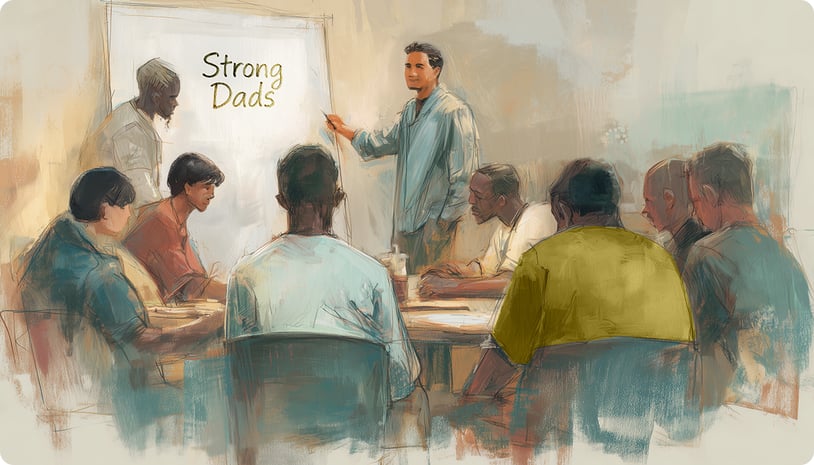
Oklahoma dads served by the Strong Dads program at Oklahoma State University’s Extension Service continue to show that they not only want to be there for their families, but that they want to become the best men and fathers they can be. Strong Dads uses National Fatherhood Initiative®’s evidence-based 24:7 Dad® curriculum to provide the scaffolding for dads’ growth, along with individual case management connecting dads to needed resources.
In February of 2025, we reported in this blog on an ongoing evaluation of Strong Dads being conducted by researchers at the university. We shared the results of a preliminary statistical analysis that involved gathering quantitative data from 600 dads who had completed the program, supplemented with qualitative data from interviews with dads and facilitators. We learned that 24:7 Dad® had contributed to statistically significant increases in dads’ hope and belief they could be good dads (i.e., greater confidence in reaching goals and ability to find ways to reach those goals), along with several other positive outcomes. (Read the article for details on those outcomes.)
This article updates the program’s impact by providing the results of additional analyses.*
Strong Dads has now served more than 800 dads throughout Oklahoma. The program’s effect is becoming even clearer.
24:7 Dad® Builds Hope
In addition to the previously-reported impacts, after dads complete the program, they’re more likely to report:
- Feeling more successful at appropriately disciplining their children.
- Supporting their children’s success in school.
- Encouraging their children to develop their talents.
- Giving their children praise and affection.
- Spending quality time with their children doing what their children like to do.
- Feeling more successful in supporting their children’s mother.
The additional analyses also find that the trajectories of dads’ improvements in some of those areas aren’t uniform. Specifically, when it comes to their hope and belief in being a good dad, their success with child discipline, supporting their children’s school success, developing their children’s talents, and supporting their children’s mother, several statistically significant patterns emerged from the data.
The lower dads “started” on those metrics at the beginning of the program, the more likely they were to have a steeper incline in their later success.
This “modeling” indicates that the program is particularly helpful for dads who, at the start of the program, are feeling less successful and hopeful than other dads!
24:7 Dad® Builds Comraderie Among Men
While there is still much to learn about some of the nuances in the program’s effect—and the “why” of its success—interviews with dads and facilitators provide some meaningful hints. The dads report learning how to be different from their own less present or absent fathers. They also appreciate:
- Learning from “veteran” dads with adult children, or who are helping raise grandchildren.
- Sharing their struggles, such as finding employment and financial stress, with other dads who understand those struggles.
- The support from a group diverse in race-ethnicity, income, and where they are on the fatherhood journey.
Finally, both Strong Dads graduates and facilitators have identified another factor they think is critical to the graduates’ growth: the camaraderie that develops over the three months they’re together. Facilitators highlight how this experience of being together in emotionally meaningful conversations—a task men often find difficult—builds a bond that counteracts the loneliness men often feel. This togetherness and connection, facilitated by Strong Dads staff and 24:7 Dad®, might be a critical ingredient in explaining dads’ remarkable growth.
Researchers will continue evaluating the program. They expect more results by the summer of 2026. We will share them in this blog.
Authors

Christopher A. Brown serves as the President of National Fatherhood Initiative® (NFI), where he is responsible for overseeing the development and implementation of NFI's strategic plan and business model, as well as its operations and fundraising efforts. |

Jordan Shuler, MS, earned a bachelor’s degree in Family Studies from Weber State University, UT, and a master’s degree in Marriage and Family Therapy at Oklahoma State University. He is currently a Ph.D. student in Human Development and Family Science at OSU and conducts research on the experience of fathers and facilitators in fatherhood program,s as well as research on committed couple relationship well-being. |
Date Published: 09/10/2025
Last Updated: 09/10/2026
Learn How to Build a Fatherhood Program That Works
Download this free guide for a proven 7-step roadmap—from making the case and securing funding for your program, to launching and measuring real results!

%201%20(1).png?width=148&height=88&name=NFI_logo_blue_left%20(1)%201%20(1).png)


