FATHERHOOD.ORG


Why Every Professional Who Works With Dads Needs This Book On Their Desk
5 min read

I realize there’s something self-serving about an author telling you that you need their book.
So, rather than tell you why every dad needs The 24:7 Dad: 12 Habits of Confident Fathers, I want to make a different case:
If you’re a professional who works with dads, you need a copy on your desk.
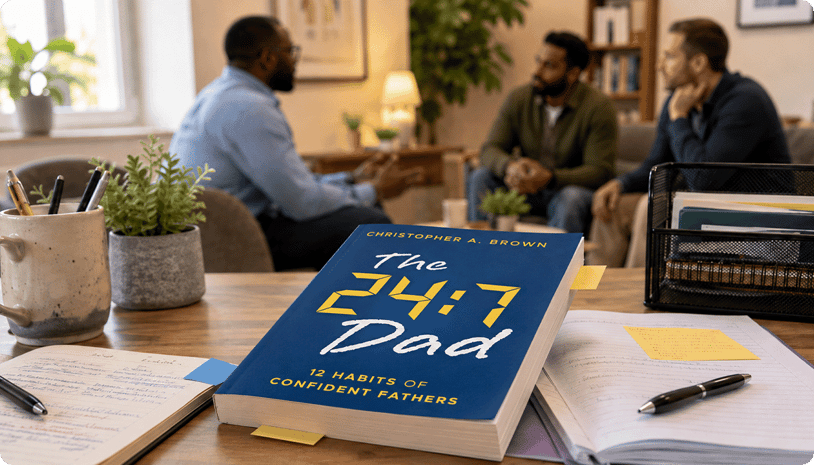
Not on a bookshelf gathering dust. On your desk—where you can underline it, add sticky notes, revisit a chapter before meeting with a dad, pull an idea from it for a group discussion, or use it to think differently about a dad who’s struggling.
While I wrote The 24:7 Dad primarily for dads, I also wrote it with people like you in mind.
Why?
Because the better you understand what helps a dad become confident in his role, the better equipped you’ll be to help him get there.
A Framework for Understanding the Whole Dad
One of the biggest mistakes I see professionals make is focusing too narrowly on what they want dads to do.
- Communicate better.
- Discipline more effectively.
- Spend more time with their children.
- Improve their co-parenting relationship.
All of those behaviors are important. But behavior doesn’t exist in a vacuum.
That’s why The 24:7 Dad is built around six traits of a confident father:
- Self-awareness
- Self-care
- Fathering skills
- Parenting skills
- Relationship skills
- Stewardship
The 12 habits develop those traits through areas such as accountability, self-reflection, physical and mental health care, healthy masculinity, nurturing children, discipline, effective co-parenting, and community involvement.
That framework can change how you look at a dad.
- If he’s struggling with discipline, he might also be struggling with emotional regulation.
- If he’s having difficulty connecting with his children, he might need to examine what he learned about masculinity growing up.
- If he repeatedly falls short of his goals, he might benefit from greater self-reflection or accountability.
- If his physical or mental health is suffering, he might have difficulty being consistently present for his children.
In other words, you need to see the man to effectively help the dad.
That’s one of the most important professional-development lessons in the book.
The 24:7 Dad Bridges Research and Real Life
After more than three decades helping professionals serving dads, I’ve seen a recurring problem. Plenty of research tells us what matters. But research doesn’t always tell you what to say to the dad sitting across the table on a Tuesday afternoon.
That gap between what we know and what we do matters.
I wrote The 24:7 Dad to help close it.
The book draws on research but translates it into practical habits dads can understand, customize, and put into practice. It doesn’t simply tell dads they should become better fathers. It helps them understand how to grow into that role.
That same structure makes it useful to you.
- Use it to deepen your understanding of why a particular dad might be stuck. Turn a concept into a conversation.
- Use a question from a chapter to spark reflection.
- Recommend a specific chapter when a dad needs help in one area rather than overwhelming him with everything at once.
This isn’t research sitting on top of a shelf.
It’s research translated into practice.
The 24:7 Dad Can Make You Better at Conversations That Matter
Think about the conversations you have with dads.
- How do I become more patient?
- How do I discipline without yelling?
- How do I deal with stress?
- How do I communicate with my child’s mother when we can barely stand each other?
- How do I become more involved when I didn’t have a good role model?
- What does being a good man and dad look like?
Those aren’t simply parenting questions. They involve identity, relationships, health, upbringing, habits, beliefs, emotions, and skills.
The breadth of The 24:7 Dad gives you a framework for engaging dads in those deeper conversations.
And we’re already demonstrating how easily concepts from the book can be translated into practice. National Fatherhood Initiative®’s Quick Confidence Builds series takes ideas inspired by the book and turns them into brief activities practitioners can use with dads in group-based or one-on-one settings.
That’s an important point.
The book isn’t a curriculum or program. It’s a professional resource you can keep returning to. Whether you facilitate a fathering program, provide case management, counsel families, work in child welfare, corrections, child support, workforce development, education, healthcare, or another setting, you can draw from it as your work requires.
The 24:7 Dad Book Comes With Useful Tools
I didn’t want professionals—or dads—to finish the last page and wonder, “Now what?”
That’s why the book’s website includes free supporting resources, including a 12 Habits Worksheet, Mentoring Guide for Professionals, the 12 Habits Model, and developmental milestone charts from birth through age 18. There’s also a video specifically for professionals that explains how to use the book effectively.
Those resources extend the book beyond reading and into something for practical use.
And that’s what professional development should ultimately do. It should change something about the way you think, the questions you ask, the resources you recommend, or the way you approach the people you serve.
Don’t Take My Word for It
You might reasonably think, “Of course Chris believes his book belongs on my desk. He wrote it!”
Fair enough.
So, consider what people with vast experience in helping dads have said about it.
Kyle Pruett, M.D., Ph.D., of the Yale Child Study Center emphasizes The 24:7 Dad book’s ability to help dads understand their importance and build confidence.
David Cozart of the Commonwealth Center for Fathers and Families points to The 24:7 Dad book's combination of theory, research, and practical application and calls it a resource for professionals and researchers as well as dads.
Kelly Kendall of Utah State University describes The 24:7 Dad as a strong asset for fatherhood programs, educators, and practitioners.
And Ron Hauenstein, Executive Director of the Spokane Fatherhood Initiative, brings a particularly valuable perspective. Since 2018, his organization has graduated hundreds of dads from the group-based 24:7 Dad® program. Based on that experience, he strongly recommends The 24:7 Dad book and points to the power of these habits in helping dads develop not only the tools and skills they need, but also the beliefs, values, and confidence.
These perspectives come from researchers, educators, program leaders, and others who have spent years learning what dads need.
That matters to me, as I trust it does to you.
Before You Give The 24:7 Dad Book to a Dad, Read It Yourself
I certainly want dads to read The 24:7 Dad. I wrote it for them. But if you work with dads, here’s my challenge:
Read it first as a professional.
- Underline ideas that challenge your assumptions.
- Flag pages that could help with common issues you encounter.
- Think about the dads you serve as you work through the 12 habits.
- Consider which of the six traits your organization addresses well—and which ones you might be overlooking.
Then keep the book nearby. Because the most valuable professional resources aren’t always the ones you read once and put away. They’re the ones you return to when a situation, question, or person makes you think:
I know there’s something in here that can help.
That’s why every professional who works with dads should have a copy of The 24:7 Dad: 12 Habits of Confident Fathers.
Not just on your bookshelf.
On your desk.
What professional development challenges do you face in serving dads? What have you done to address them?
In what ways can you see using the book to serve dads?
Date Published: 10/27/2026
Last Updated: 10/27/2026
Learn How to Build a Fatherhood Program That Works
Download this free guide for a proven 7-step roadmap—from making the case and securing funding for your program, to launching and measuring real results!