FATHERHOOD.ORG


5 Ways to Make Your Programs More Father-Inclusive
5 min read

Are your programs designed to actively engage fathers, or are fathers simply welcome to participate if they show up?
This four-part series explores the four categories of National Fatherhood Initiative®’s Father Friendly Check-Up™ and the role each plays in creating a truly father-inclusive organization. Each article focuses on one category—Leadership Development, Organizational Development, Program Development, and Community Engagement—and offers practical ways to turn a commitment to father inclusion into everyday action.
In the first two articles, we examined how Leadership Development establishes the expectation that fathers matter and how Organizational Development builds that expectation into everyday policies, procedures, and staff practices.
But even a welcoming organization can miss fathers if its programs are not designed around their needs, interests, and circumstances. That brings us to Program Development, the third category of the Father Friendly Check-Up™.
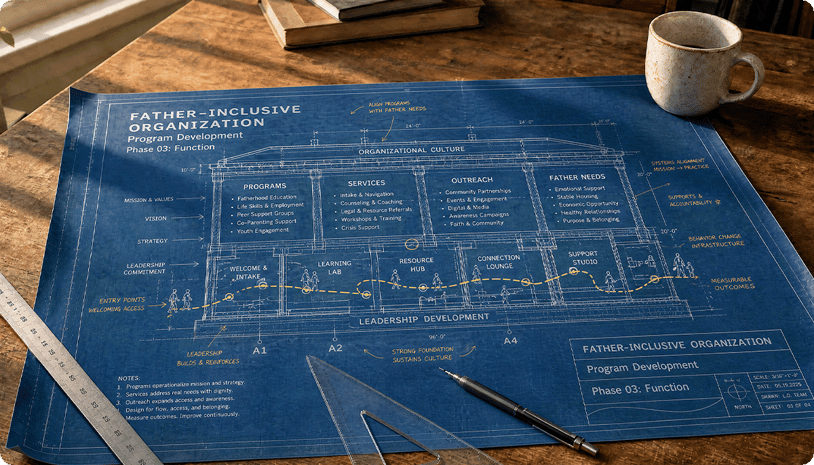
Program Development examines the services and programs an organization offers, how it engages staff in offering them, and how it promotes and markets them. The Father Friendly Check-Up™ asks organizations to consider their offerings as a whole—not just a single fatherhood program.
Consider a parenting workshop held only during the workday, a family program whose examples speak almost exclusively to mothers, or a class that relies on lectures when participants would benefit from hands-on activities. Fathers may technically be eligible, but the program itself may not invite their meaningful participation.
Here are five practical ways, drawn from the Program Development category of the Father Friendly Check-Up™, to make your organization’s programs more father inclusive.
1. Design Programs to Include Fathers From the Start
If you want fathers to participate in your programs, design them with fathers in mind rather than trying to engage them after the programs are already running. For example, imagine a family resource center developing a new parenting program. Instead of designing the program primarily around mothers, and later inviting fathers to participate, the center seeks input from both mothers and fathers during the planning process. It considers fathers’ schedules, interests, parenting experiences, and potential barriers to participation before deciding on the program’s content, activities, and delivery methods. The Father Friendly Check-Up™ asks whether programs designed for parents proactively include fathers, use a strengths-based, whole-family approach, and incorporate evidence or research about what may be typical or unique about fathers.
Review your parenting and family offerings. Are fathers represented in examples, scenarios, and activities? Do program goals recognize the contributions fathers make to their children’s lives? Does the content encourage healthy co-parenting and acknowledge different family structures?
A whole-family approach does not mean every activity must involve both parents. It means recognizing fathers as important family members and intentionally creating appropriate opportunities for them to participate.
Try this: Select an existing parent-focused program and examine its objectives, materials, and activities. Identify two changes that would speak more directly to fathers and encourage their program participation.
2. Make Participation Fit Fathers’ Lives
A program can be excellent and still fail to reach fathers if they cannot realistically attend. The Father Friendly Check-Up™ examines whether programs are offered at convenient times for fathers to attend and provide multiple ways to participate, including in-person, self-paced, and partially or fully virtual options.
Think about fathers who work during the day, travel for work, share parenting time, or have transportation challenges. A single meeting time or delivery format can unintentionally exclude them. Offering an evening group, an individual session, an online option, or a self-paced resource may open doors that a traditional schedule leaves closed.
This does not mean every organization must offer every format immediately. Start by asking fathers what works for them and testing an alternative that fits your staffing and resources.
Review program attendance patterns and ask: Are our programs convenient for the fathers we want to serve, or only convenient for us to deliver?
3. Offer Content That Addresses Fathers’ Needs
Fathers need more than a general invitation to a parenting class. They need information and support that connect with the challenges and opportunities they experience.
The Father Friendly Check-Up™ examines whether organizations provide resources on co-parenting, child discipline, child development, men’s physical and mental health, and work-family balance. It also addresses issues such as paternity, custody, visitation, child support, child welfare, family violence, conflict resolution, grief, anger management, healthy masculinity, and how a father’s upbringing shapes his parenting.
Not every organization will provide direct services on all these topics. But organizations can review what they offer, identify gaps, and share relevant information or referrals. Materials should also reflect the diversity of the fathers being served.
Ask fathers which topics would make the greatest difference in their lives. Their answers may challenge your assumptions about what they need most.
4. Use Activities That Engage Fathers, Not Just Inform Them
How information is delivered can matter as much as what is taught. The Father Friendly Check-Up™ asks whether programs use activities, materials, and individual and group exercises that appeal to fathers, including hands-on, interactive, visually engaging approaches and opportunities for discussion and debate.
Consider the difference in using a long lecture versus a role-play to teach fathers an effective child discipline technique. One only communicates information about the technique and how to apply it. The other does both and gives fathers a hands-on, interactive opportunity to practice it, and build confidence in using it, before trying it with their children.
Look for opportunities to include demonstrations, scenarios, small-group conversations, problem-solving exercises, and father-child activities where appropriate. Avoid assuming all fathers learn alike; offer varied activities and ask fathers which approaches help them most.
Take a portion of any workshop or program you currently deliver to dads and replace any part of it that’s delivered in a lecture format with an interactive exercise that provides a hands-on learning opportunity. Then ask fathers whether the change made the content more useful and practical.
5. Let Fathers Help You Improve Your Programs
A father-inclusive program should not be designed once and left unchanged. The Father Friendly Check-Up™ asks whether organizations periodically survey fathers about their needs, concerns, and interests; evaluate how effectively programs include fathers; and monitor fathers’ involvement in their children’s lives and families. It also encourages organizations to learn from others that have successfully served fathers.
Gather feedback from fathers before, during, and after program participation. Ask fathers what attracted them to the program, what made attendance difficult, which activities were most valuable, and what they would change. Review whether fathers are enrolling, attending, completing programs, and reporting meaningful changes in their involvement with their children.
Feedback only matters if it influences decisions. Share what you learn with staff, select one improvement, evaluate the results, and adjust as needed. A small adjustment based on fathers’ experiences can be more valuable than a large change based on assumptions.
The Father Friendly Check-Up™ also highlights opportunities to celebrate fathers’ accomplishments and recognize fatherhood through special events. Recognition can reinforce the message that fathers’ participation matters.
Move From Father-Friendly Intentions to Father-Inclusive Programs
Leadership can communicate that fathers matter. Organizational systems can make them feel welcome. But Program Development determines whether the services fathers encounter are relevant, accessible, engaging, and responsive to their needs.
Take a look at your organization’s programs and ask: If a father wanted to participate tomorrow, would he find an offering designed with him in mind—or would he have to adapt to something designed primarily for someone else? What one change could you make to improve his experience?
Have you taken the Father Friendly Check-Up™? If not, allocate one hour within the next week to do so.
Are you looking for a parenting program designed for fathers? National Fatherhood Initiative® designed its evidence-based 24:7 Dad® program with dads in mind.
Date Published: 11/10/2026
Last Updated: 11/10/2026
Learn How to Build a Fatherhood Program That Works
Download this free guide for a proven 7-step roadmap—from making the case and securing funding for your program, to launching and measuring real results!